
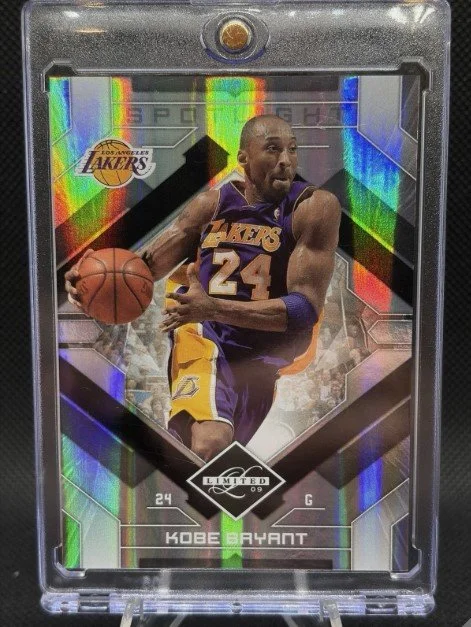
Back in January 2026, I acquired a 2009-10 Kobe Bryant Limited Spotlight Silver /25 for $250. It’s an awesome card. Low numbered. Kobe. Beautiful design. Exactly the kind of card I was perfectly happy owning.
Then, back in early May, I decided to list it on eBay for $2,500. Yes, $2,500. Ten times what I had paid for it just a few months earlier. Did I actually expect someone to pay $2,500? No, not really.
It was more of a: “Make me sell it.” I liked the card. I didn't need to sell it. But if someone wanted to pay a crazy price for it, I was willing to listen. For more than three months, absolutely nothing happened. Zero offers.
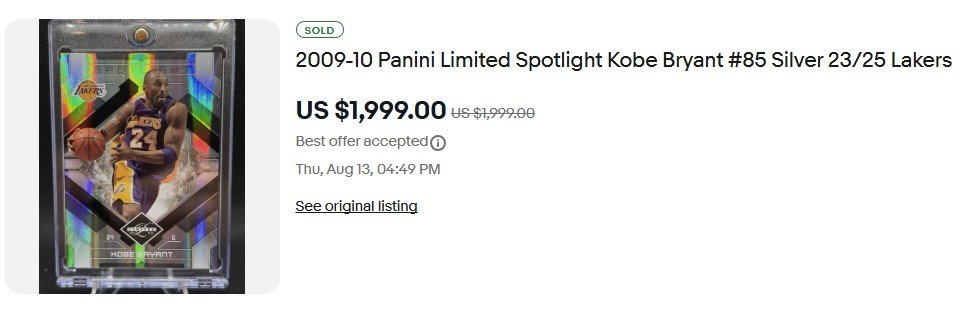
Then, completely out of nowhere, an offer came in: $1,999.
I accepted. A card I had purchased for $250 just a few months earlier sold for nearly $2,000. And I'm still kind of shocked that it happened.
The “I Don’t Really Want to Sell It” Price
Most of the cards I list have a fairly normal pricing strategy behind them. I look at recent sales. I look at similar cards. I consider the player, rarity, condition and current market. Then I try to establish a reasonable asking price while leaving myself some room to negotiate.
But occasionally I have a card where that process doesn't really apply. It's a card I like enough that I don't particularly care if it sells. That's where the “make me sell it” price comes in.
For this Kobe, that number was $2,500.
Was that aggressive? Absolutely. That was the point.
I wasn't trying to price it for a quick sale. I wasn’t even necessarily trying to actually sell it. I was essentially putting the card on display with a price attached that said: “if somebody values this card enough to get somewhere near this number, I'll let it go. Otherwise, it stays with me.” And for months, nothing happened.
Then It Happened
The card sat. No offers. No negotiations whatsoever. Nothing that made me think a sale was imminent.
And that's an important part of this story because it's very easy as a seller to interpret inactivity as evidence that your price is wrong. Sometimes it is.
But sometimes the right buyer simply hasn't seen the card yet. Tonight, the right buyer apparently did.
They offered $1,999.
That's about 80% of my $2,500 asking price, and at that point there wasn't much for me to think about. I accepted. Could I have countered at $2,100? $2,200? Maybe. Could I have squeezed another hundred or two out of the deal? Possibly.
I also could have watched the buyer disappear and then spent the next six months wondering why I didn't take $1,999 when I had the chance.
Considering I had just $250 into the card, there was absolutely no reason for me to get cute over the last couple hundred dollars. The offer had already accomplished exactly what my listing price was designed to do.
It made me sell it.
It Only Takes One
This sale reinforced something I'm learning over and over again with sports cards:
You don't need everyone to agree with your price.
You need one person. That's especially true with rare cards. A /25 Kobe isn't a commodity where there are 50 identical copies listed and buyers can easily establish exactly what the card should cost. There are only 25 copies.
How many are actually available? How many are sitting permanently in collections? How many are in comparable condition? And how many are available right now, when a particular collector decides they want one? That changes the pricing equation.
The market value of a rare card isn't necessarily whatever the average buyer would pay. Sometimes it's whatever one motivated collector is willing to pay when the card becomes available.
What I Paid Doesn't Determine What It's Worth
There's another lesson here that the $250 purchase really drives home. What I paid for a card has nothing to do with what the next buyer should pay for it.
It would have been easy to look at my $250 cost and think: “If I can sell this for $500 or $600, I've made a fantastic return.” And mathematically, that's obviously true. But that's the wrong way to price a card. The market doesn't care what I paid. If I happened to buy a card cheaply, that doesn't mean I should automatically sell it cheaply.
My cost basis should help me decide whether I'm comfortable accepting an offer. It shouldn't determine the card's market value. In this case, buying the Kobe for $250 actually gave me the luxury of being patient.
I didn't need to squeeze a quick profit out of it. I could put a ridiculous-looking $2,500 price tag on it, enjoy owning it in the meantime, and see what happened. Turns out, something happened.
Zero Offers Doesn't Necessarily Mean Zero Interest
This might be the biggest lesson for me. For more than three months, this card generated zero offers. It would have been incredibly easy after a month to knock the price down. Then lower it again. And again. Eventually, I probably could have found a price that generated activity.
But I didn't need to. I liked the card. I didn’t need to sell it. So I waited.
Then one night, after months of silence, someone came within about $500 of my intentionally wild asking price.
That's sports cards. There can be a huge difference between “nobody wants this” and “the person who really wants this hasn't found it yet.”
This Strategy Isn't for Every Card
There's an important distinction here. I wouldn't take this sale as evidence that everything should be listed 50% above comps. For cards with lots of recent comparable sales and plenty of available supply, buyers know exactly what they're worth. Wild pricing usually just means your card sits while buyers purchase someone else's copy.
This strategy makes much more sense when several things are true:
The card is genuinely scarce.
Direct comps are limited or nonexistent.
The player has a strong collector base.
There aren't many comparable copies available.
You're completely comfortable keeping the card.
You don't need the money tied up in it.
That last one matters. A “make me sell it” price only works if you're actually willing to not sell it. Otherwise you're just overpriced.
The Value of Patience
One thing selling cards has already taught me is that patience has value. There are times when I want inventory moving quickly. There are cards where I'd rather take a good offer today, recycle the cash and buy something else. But not every card needs to be treated the same way. Some cards deserve a longer leash.
And occasionally, putting a big number on a rare card and waiting turns out to be exactly the right move.
My $2,500 Kobe listing looked pretty ridiculous for more than three months. Until someone offered $1,999. Then it didn't look so ridiculous anymore.
The Takeaway
I'm not walking away from this thinking I suddenly cracked some secret sports-card pricing formula. If anything, it reinforces how unpredictable this market can be.
But I am taking one lesson from it:
Don't automatically be afraid of an aggressive asking price when you own the right card.
If the card is scarce, desirable and something you're happy to hold, there's nothing wrong with testing the market. You can always lower the price later. You can't go back and raise the price after somebody has already bought it. Sometimes the listing will sit for months. Sometimes nobody will ever pay your number. And sometimes, on a random Thursday night after months without a single offer, somebody will throw $1,999 at the Kobe card you weren't really planning to sell. Because in the end, it only takes one.
One More Twist
And here's a fun little postscript to the story.
The buyer who paid me $1,999 apparently had his own “make me sell it” price. They listed it back on eBay for $3,000 - as of the writing of this post (October 2026) the listing is active.
Maybe he'll get it. Maybe he'll eventually take $2,500. Maybe it'll sit there for the next two years. Who knows?
But that's actually the perfect ending to this story. I was thrilled to turn a card I bought for $250 into a $1,999 sale. The buyer was apparently comfortable paying $1,999 because he believes there's potentially another level above that. Neither of us necessarily has to be wrong.
With a scarce card like a Kobe /25, there isn't always one perfectly defined “market price.” Sometimes it's simply a matter of finding the right buyer at the right time.
I found mine.
Now he's looking for his.
