How Do You Price a 1/1 Sports Card With No Comps?
One of the things I'm learning as a relatively new sports card seller is that sometimes you end up with a card that doesn't have an obvious price.
Recently, I acquired a true 1/1 from a major football product. Normally, I'd start pricing a card by looking at recent sales. But that's difficult when you own the only copy that exists. There were no direct comps.
So how do you price it? And maybe more importantly: once someone makes an offer, how do you know when to actually sell it?
I recently had to figure that out.
Finding Comps When There Aren't Any
Obviously, searching for previous sales of the exact card wasn't going to work. Instead, I started looking sideways.
I found sales of the same 1/1 parallel featuring different players. One was a more established offensive star that had sold for approximately $600. Another was a less-established rookie that sold for approximately $325.
Neither was a perfect comparison. But now I had two reference points.
Based on the player's popularity, position, accomplishments and collector demand, I thought my card probably belonged somewhere between them.
That gave me a rough valuation range of around $400–$550, depending on the buyer.
That's a pretty wide range, but with a card like this, I think pretending you can value it more precisely than that is probably false precision.
I Listed It at $749
If I thought the card was probably worth somewhere around $400–$550, why list it for $749?
Because I wasn't in a hurry to sell it. More importantly, I didn't want to accidentally establish the ceiling myself.
If I listed the card for $449 and someone immediately bought it, I'd never know whether that same person would have paid $500, $600 or more. I can always lower a price. I can't ask the buyer for more money after the sale.
So I listed it at $749 with offers enabled and waited to see what happened. It didn’t take long.
Then the First Real Data Point Arrived
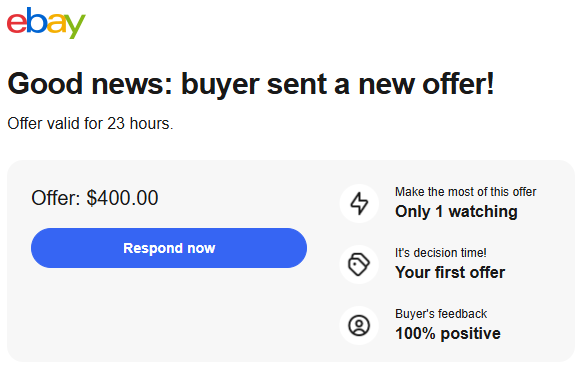
A buyer offered $400.
Now things got interesting.
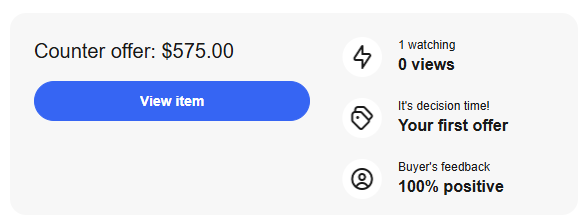
Until that point, all I had were comparable sales and my own estimate. This was the first time someone had actually put real money behind a valuation of this specific card.
I didn't accept.
I countered at $575.
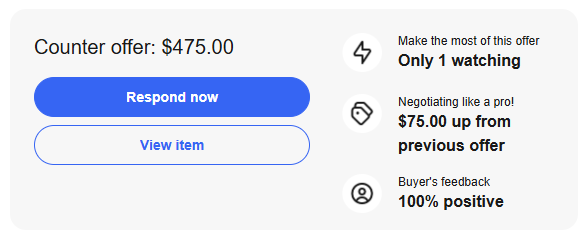
The buyer came back at $475.
And that's where the decision became much harder.
Do You Push for Another $25 or $50?
My first instinct was to counter again. Maybe $525. The buyer had already moved from $400 to $475, so there was a reasonable chance they would come up again. Maybe we'd eventually settle at $500.
But then I started thinking about the other side of owning a 1/1. Yes, there's only one card. But how many buyers are there when it isn’t a premium player.
Scarcity Works Both Ways
It's easy to look at a 1/1 and think: "There's only one. I control the market."
Technically, that's true.
But there might also only be a handful of collectors willing to spend several hundred dollars on that particular player, from that particular set, at that particular moment. That creates an interesting situation. The supply is incredibly limited. But so is the demand.
A $475 offer from an actual buyer is very different from believing that a hypothetical buyer might eventually pay $525.
Could I have countered at $525 and gotten it? Possibly.
Could the buyer have come back at $500? Absolutely.
Could they also have decided $475 was their limit and walked away or ghosted me? Yep.
And if that happened, I might be sitting on the card for months waiting for another serious buyer to appear.
All over another $25 or $50.
I Took the $475
Ultimately, I accepted the $475 offer.
Was that the absolute maximum amount I could have gotten for the card? I'll never know. And that's okay.
The sale landed almost exactly where the comparable sales suggested it should.
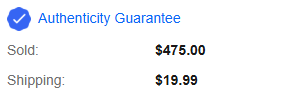
More importantly, I had a legitimate buyer willing to pay $475 for a card with a relatively small potential buyer pool. I decided the additional upside from another counter wasn't worth risking the sale.
That's something I'm learning about selling cards in general:
Maximizing every individual transaction isn't necessarily the same thing as running a good business.
Sometimes taking a strong, reasonable offer and putting the money back to work is the better move.
What I Learned About Pricing Cards With No Comps
This experience gave me a basic framework I'll use the next time I encounter a card without a direct comp.
1. Stop looking for the exact card.
If it's extremely rare, the sale you're looking for may not exist.
2. Look sideways for comparable sales.
Same set. Same parallel. Similar players. Similar positions. Similar rarity. None will be perfect, but collectively they can establish a range.
3. Think in ranges, not exact values.
I didn't decide this card was "worth $487." I concluded it was probably somewhere around $400–$550. That's much more realistic.
4. Start high if you have time.
Listing at $749 didn't mean I expected someone to pay $749. It gave me room to negotiate without accidentally selling too cheaply.
5. Treat real offers as new information.
A $400 offer wasn't just someone trying to get a deal. It was a real data point. When that buyer increased to $475, it became an even stronger one.
6. Consider the size of the buyer pool.
This might have been the biggest lesson. Scarcity alone doesn't determine value. A card can be incredibly rare and still have a limited market.
7. Don't lose a good sale chasing the perfect sale.
Maybe another $25 or $50 was available. Maybe it wasn't. At some point, you have to decide whether the potential additional profit is worth the risk of losing the buyer you already have. For me, at $475, it wasn't.
The Final Scorecard
Initial list price: $749
First offer: $400
My counter: $575
Buyer's counter: $475
Final sale:$475
No direct comps. The comparable cards helped establish the range. Listing high protected my upside. The negotiation revealed what an actual buyer was willing to pay. And then I had to make a decision.
That's one of biggest things I'm learning about pricing sports cards: comps are incredibly useful, but they don't make the decision for you.
Sometimes you gather the information you have, decide what constitutes a good sale, and take the money that's actually sitting in front of you.
