
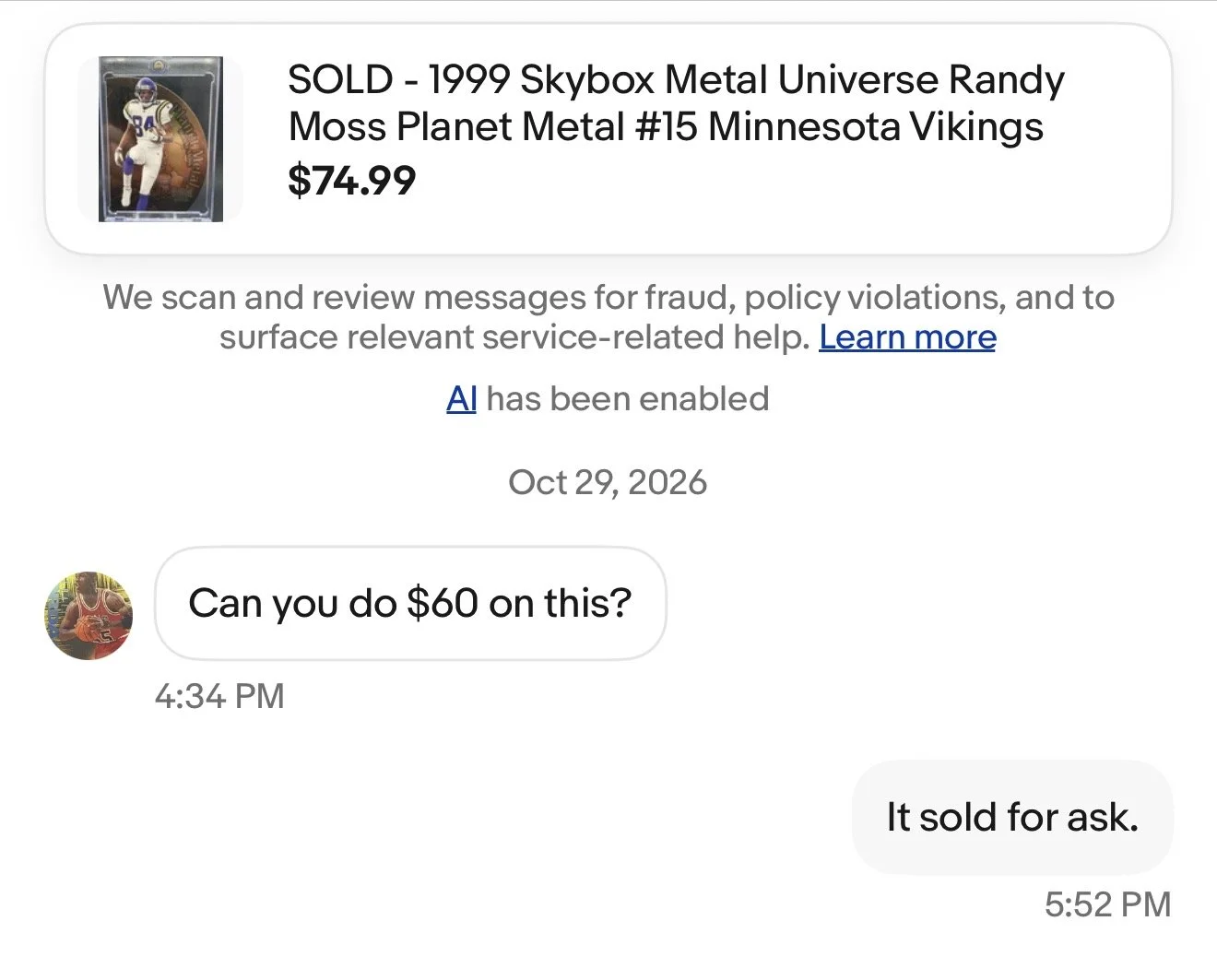
If you've sold sports cards on eBay for any length of time, you've probably received your fair share of lowball offers. You list a card for $100, and someone offers $40. You list another for $250, and someone comes in at $100.
It's part of selling on eBay, and I've never really taken offense to it. Buyers are looking for deals. I get it. But as I've spent more time selling, my approach to handling offers has changed. I've gone from responding to offers, to letting low offers sit unanswered, to recently experimenting with turning offers off altogether.
And interestingly enough, I haven't noticed much of a difference in sales.
Why I Started Ignoring Low Offers
For a while, my strategy was pretty simple. If an offer was reasonably close to what I'd accept, I'd counter. If it was ridiculously low, I'd just let it sit. There was actually some logic behind that decision.
When a buyer submits an offer, eBay sometimes displays a message on the listing indicating that an offer has been received. Other potential buyers don't know how much that offer was. They just know someone else has expressed interest. That can potentially work in your favor. Someone looking at a card might see that another offer has been submitted and decide they don't want to risk missing out.
Does it actually lead to more sales? I have no way of knowing. But I figured there wasn't much downside to letting an unrealistic offer sit there until it expired.
Why I Didn't Immediately Decline
I've never really understood the need to immediately decline every lowball offer.
If someone offers $50 on a card I have listed for $150, and I have absolutely no intention of selling it anywhere near that price, what do I gain by declining? Not much.
The buyer might come back with something better. Another buyer might purchase it outright. Or the offer simply expires. I'm generally not in a rush to sell my cards, so I don't feel obligated to negotiate every time someone submits an offer.
Of course, if someone offers $130 on that same $150 card, that's a different story. Now we're having a legitimate conversation. But the really low offers? I usually just ignored them.
Why I Didn't Set Minimum Offer Amounts
Of course, eBay gives sellers the option to establish a minimum acceptable offer amount. If someone submits an offer below that threshold, eBay automatically declines it. That would certainly eliminate a lot of the lowball offers. But I generally chose not to use that feature.
My thinking was that I wanted as much engagement with potential buyers as possible. Even if someone submitted a ridiculously low offer, at least they were interested enough in the card to make an offer. Maybe they'd come back with something better. Maybe we'd eventually negotiate a deal. Or maybe the activity would help attract another buyer.
I didn't want to automatically shut down those opportunities by setting a minimum.
Looking back, though, I've started questioning whether all that additional engagement was actually accomplishing anything. Sure, I was receiving more offers. But how many of those offers were ever going to turn into legitimate sales? That's part of what led me to rethink my approach entirely.
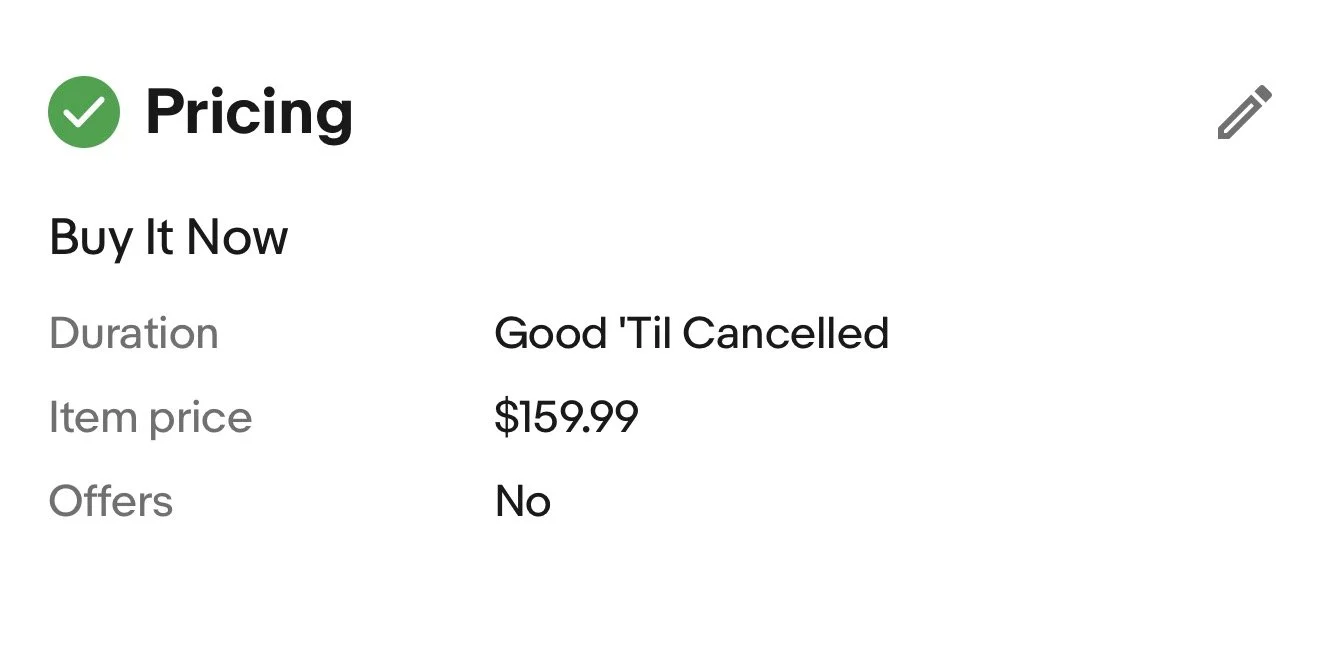
Then I Started Turning Offers Off Entirely
More recently, I decided to try something different.
Instead of listing cards higher than market value to leave room for negotiation, I started pricing more closely to what I believed the market supported and simply turning off Best Offer.
My thinking was straightforward. If I believe a card is worth $100, why not just list it at $100? Why list it at $125, invite offers, and spend time negotiating my way back down to $100?
Obviously, there's nothing wrong with negotiating. I've made plenty of sales that way. But I wanted to see whether eliminating that back-and-forth would actually hurt sales.
So far, I haven't noticed much of a difference. I'm getting fewer interactions on listings, which makes sense. Without the Best Offer button, buyers have fewer opportunities to engage. But actual sales? They seem to be holding up just fine. That's been the interesting part of this experiment.
Buyers Can Still Message You
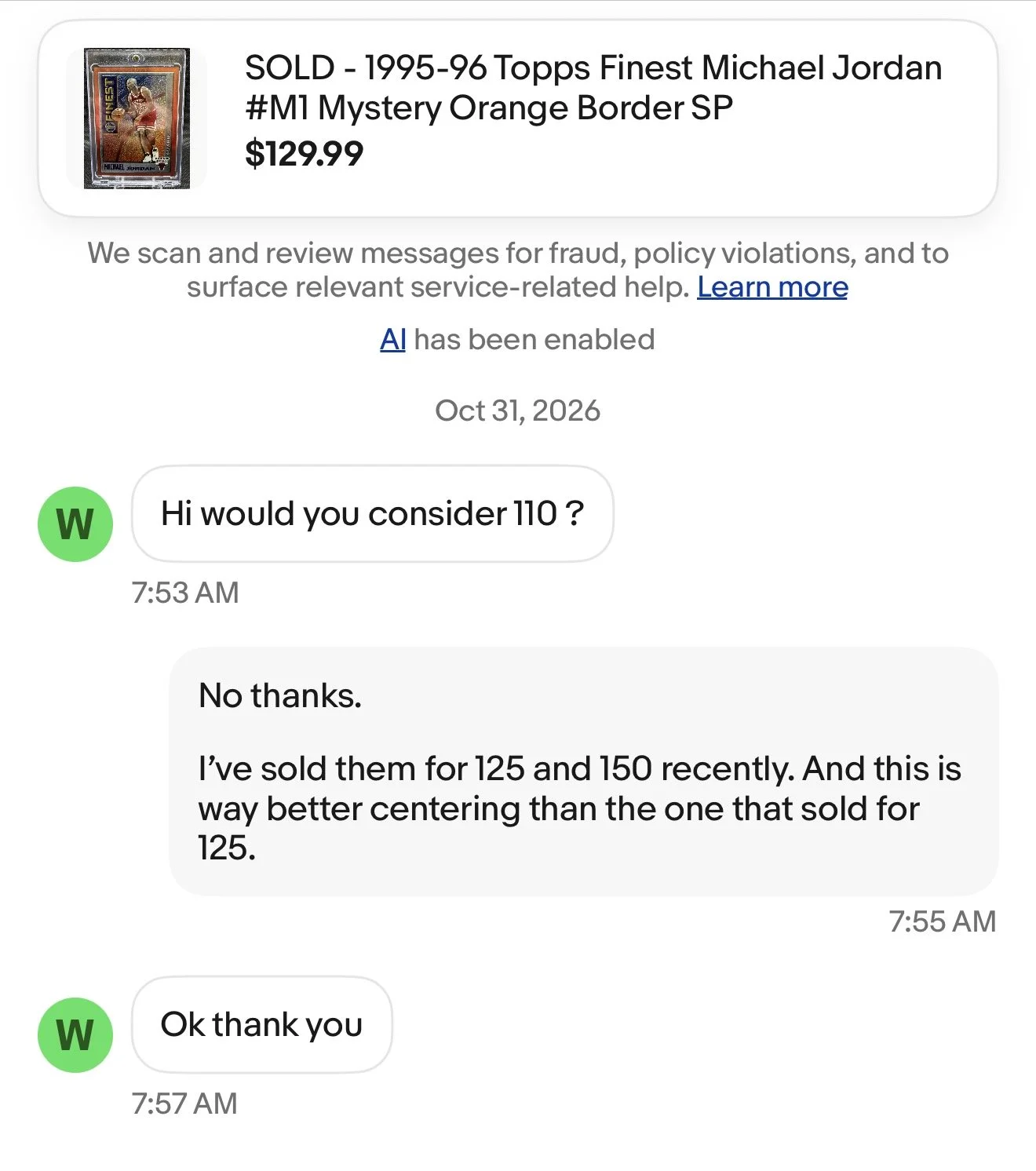
Turning off Best Offer doesn't mean negotiations disappear entirely. Buyers can still send messages — and they do. I've had people reach out asking whether I'd consider a particular price, even when offers are disabled. And that's perfectly fine with me.
If someone is serious enough about a card to send a message, I'm happy to have a conversation.
I can always decide whether to negotiate, adjust the price, or leave things exactly as they are.
The difference is that I'm no longer inviting every buyer to submit an offer with the click of a button. And that has essentially eliminated the number of lowball offers I have to deal with.
Does Turning Off Offers Hurt Sales?
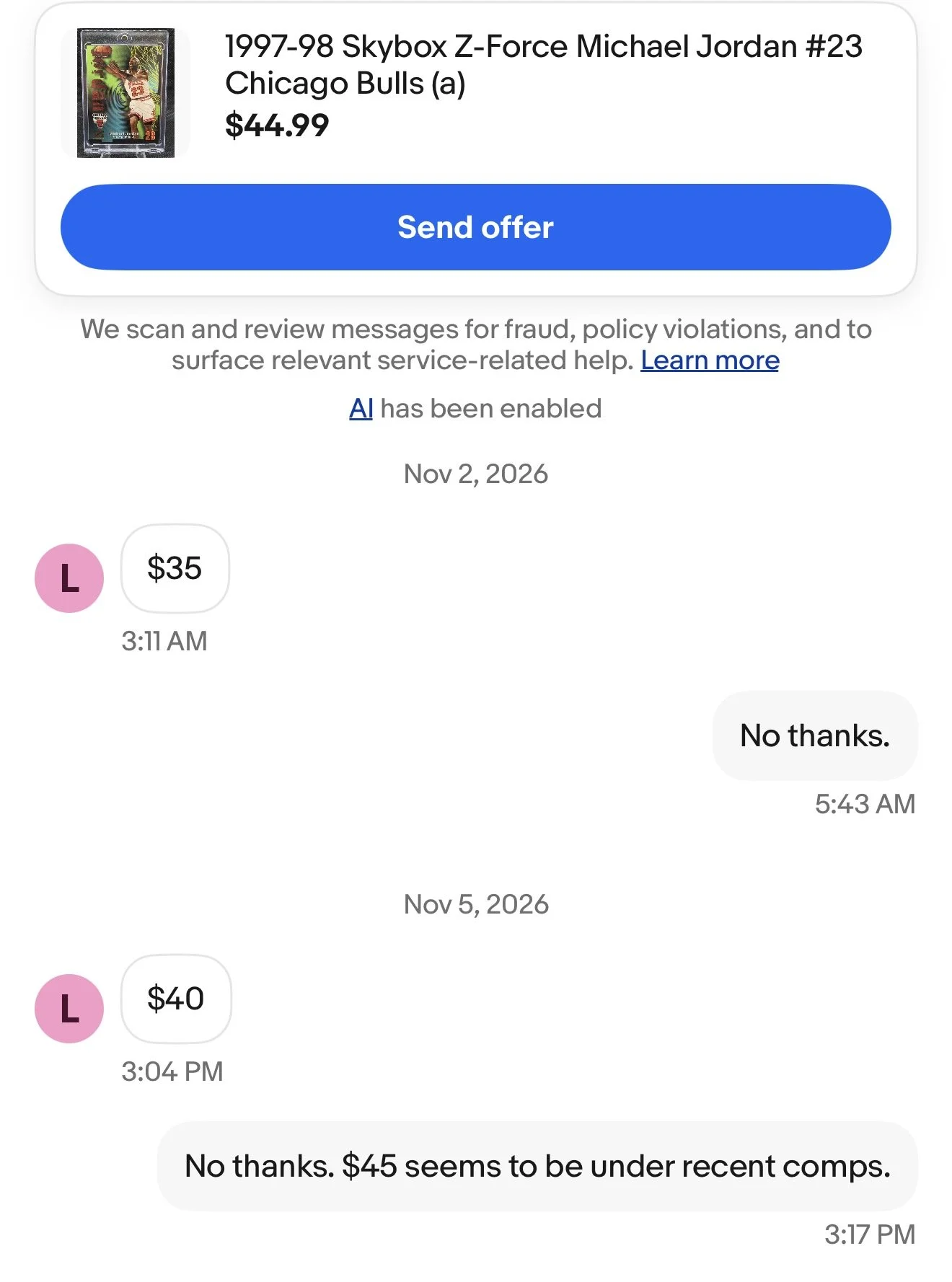
This was my biggest concern.
There's an argument that enabling Best Offer encourages engagement and helps convert buyers who might otherwise move on. I think there's some truth to that.
But there's also an argument that a fairly priced card doesn't necessarily need a negotiation option. If someone wants the card and the price is competitive, they'll buy it. At least that's the theory I'm testing.
So far, I haven't seen a noticeable difference in sales since making the change.
Now, I'm not claiming that turning off offers increases sales or that it works for every seller. I haven't conducted some scientific experiment, and there are plenty of other factors that affect how quickly cards sell.
But based on my experience, I'm becoming less convinced that Best Offer needs to be enabled on every listing.
I'm Not Completely Against Offers
There are still situations where I think Best Offer makes sense and I still use them.
For example:
Rare cards with limited comparable sales. Sometimes it's difficult to establish a precise market value, and offers can help reveal what buyers are willing to pay.
Higher-priced cards. A little negotiating room can make sense when dealing with more expensive inventory.
Cards I'm motivated to move. If something has been sitting for a long time, I'm more willing to entertain offers.
Cards priced above market intentionally. I occasionally list cards at prices where I'm perfectly happy keeping them unless someone makes an offer I can't refuse.
That last category is particularly relevant to how I sell.
I've had cards listed at what I considered pretty aggressive prices, only to eventually receive an offer that made selling worthwhile. I'm not abandoning that strategy. I'm just becoming more selective about which listings actually need an offer option.
My Approach Today
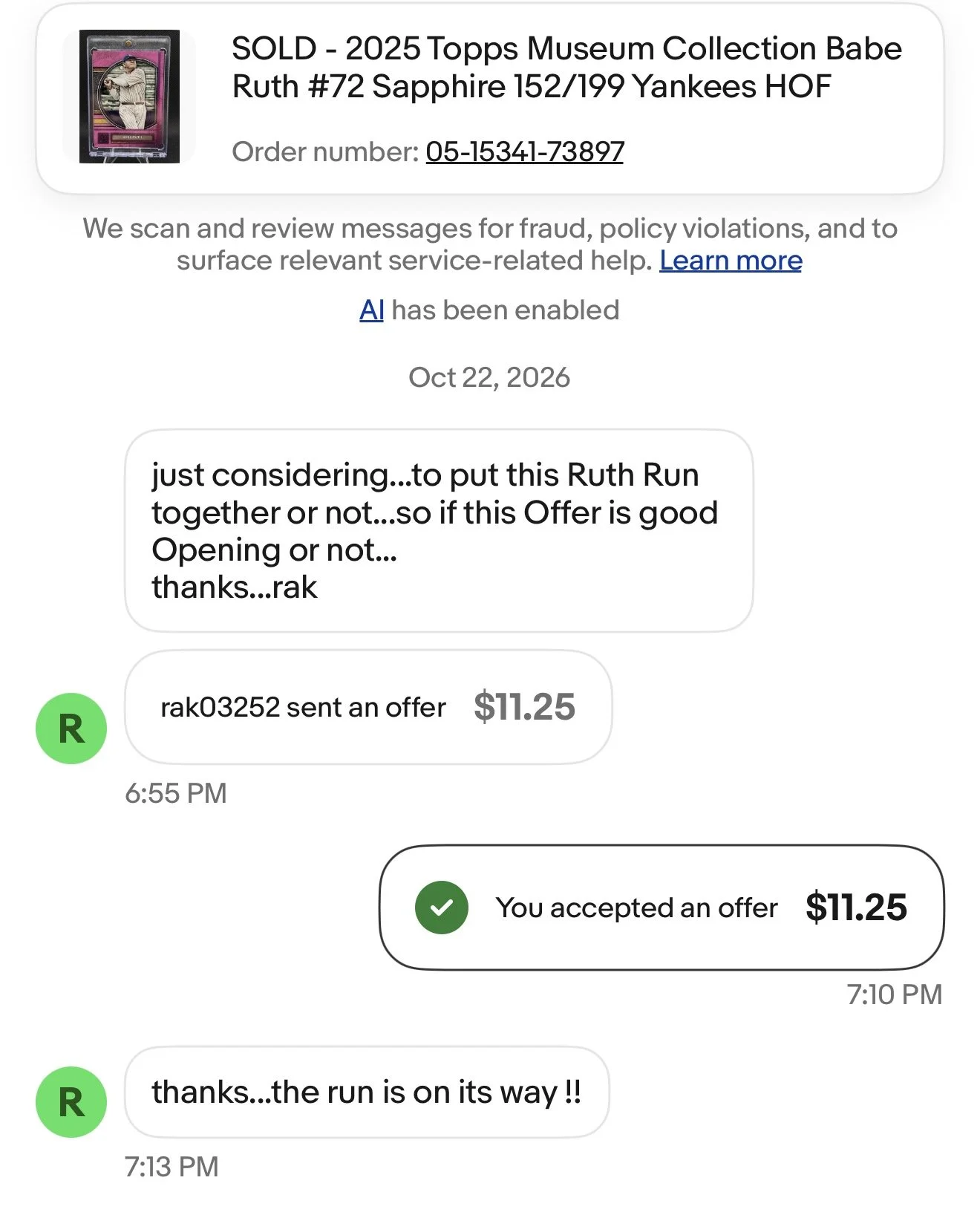
My strategy has evolved into something pretty simple.
For cards with an established market value: I'm increasingly inclined to price them competitively and turn offers off.
For rare or difficult-to-price cards: I'll consider leaving offers enabled to see what kind of interest exists.
For cards I'm happy to hold: I'll price them where I want and wait for the right buyer with offers enabled.
For listings with offers enabled: I'll still counter reasonable offers and generally ignore the unrealistic ones.
There's no single approach that works for every card.
Final Thoughts
When I first started selling, I assumed having Best Offer enabled was simply part of the process. More offers meant more engagement, and more engagement should theoretically mean more sales.
For a while, I wanted as much buyer engagement as possible. I left offers enabled, avoided minimum offer thresholds, and generally let lowball offers sit rather than declining them. But more engagement doesn't necessarily mean more sales.
Since pricing more closely to market and turning offers off on more listings, I've had basically zero lowball offers, far fewer unnecessary negotiations, and seemingly no meaningful impact on sales.
That could change. I'm still paying attention to how things perform. But for now, I'm finding that sometimes the simplest approach is the best one. Price the card fairly, put it in front of buyers, and let the market decide.
Not every sale needs to start with a negotiation.
